
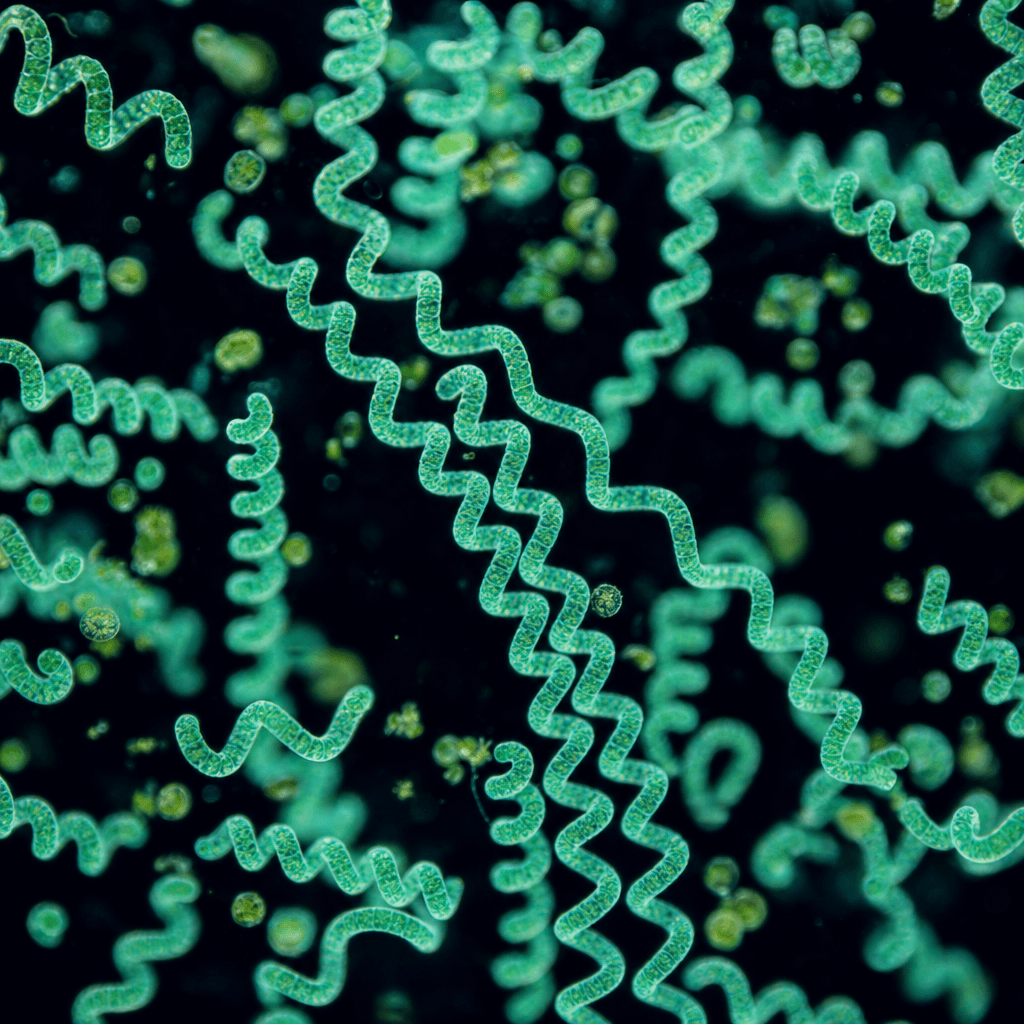
Spirulina (genus Arthrospira) is, strictly speaking, a filamentous prokaryotic cyanobacterium, although it is usually grouped with microalgae due to its use and cultivation. It forms spiral trichomes and grows in alkaline, high-pH fresh waters. It is one of the most FAO-documented microalgae-based foods, with a very high protein content.
Characteristics
- ▪Spiral-shaped filaments (trichomes), visible under the microscope.
- ▪Very high protein content (≈ 60–70 % of dry weight, per FAO and literature).
- ▪Rich in phycocyanin (blue pigment), iron and B-group vitamins.
- ▪Grows in alkaline (high-pH) waters, which reduces contamination.
Cultivation
It is produced mainly in open raceway ponds in alkaline (bicarbonate) fresh water, using its high pH as a natural barrier against contaminants. It is also grown in photobioreactors for greater control.
Applications
FAQ
Technically it is a cyanobacterium (prokaryote), but it is grouped with microalgae due to its cultivation and food use.
It is the signature blue pigment of Spirulina, valued as a natural colorant and antioxidant.
Sources
- FAO (2008). A review on culture, production and use of Spirulina as food for humans. FAO Fisheries and Aquaculture Circular.
- Richmond, A. & Hu, Q. (eds.) (2013). Handbook of Microalgal Culture: Applied Phycology and Biotechnology. Wiley-Blackwell.
- Spolaore, P. et al. (2006). Commercial applications of microalgae. Journal of Bioscience and Bioengineering, 101(2), 87–96.
- Khan, M.I., Shin, J.H. & Kim, J.D. (2018). The promising future of microalgae: current status, challenges, and optimization of a sustainable and renewable industry for biofuels, feed, and other products. Microbial Cell Factories, 17:36.
Scientific outreach based on specialised literature. Scientific review: pending.