
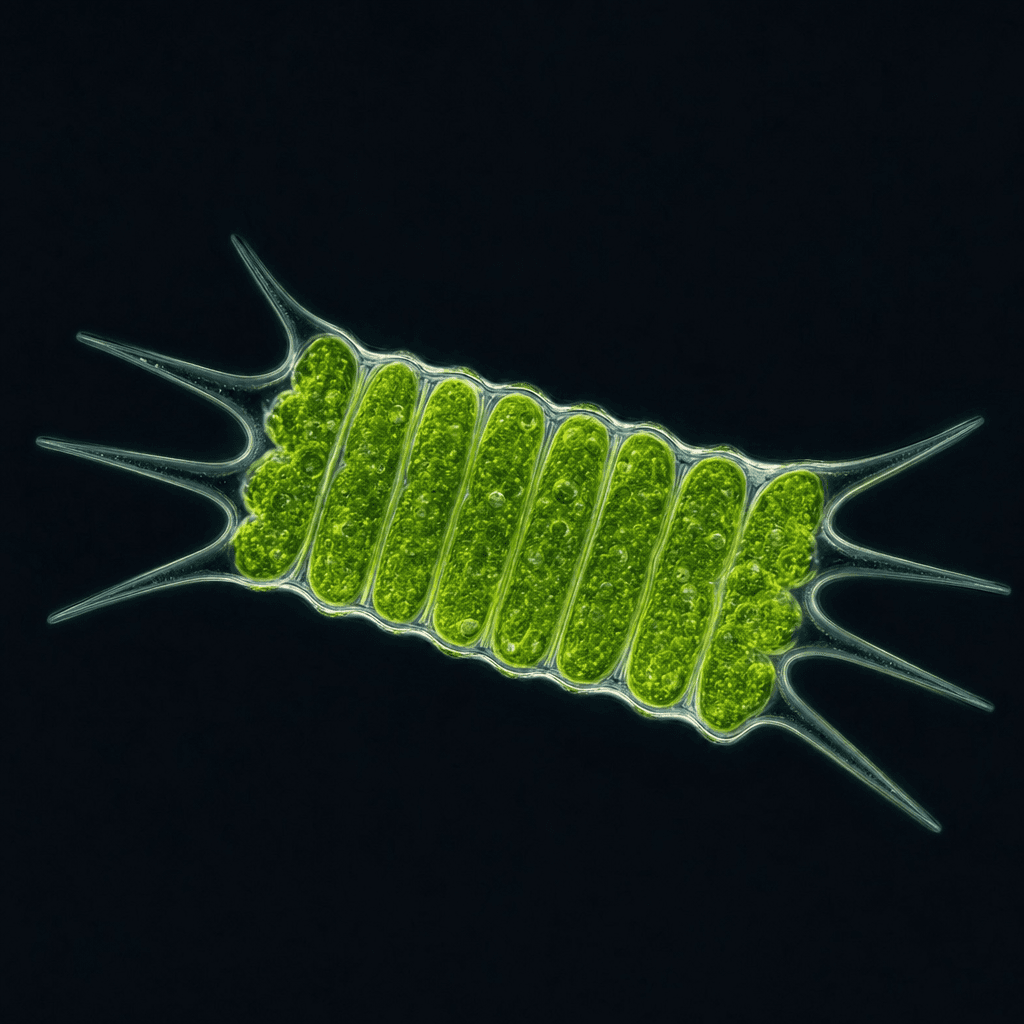
Scenedesmus is a genus of freshwater green microalgae arranged in coenobia (colonies) of 4 to 8 cells. It is very common in inland waters and stands out for its robustness, fast growth and tolerance to variable conditions, which makes it widely studied for biofuels, water treatment and biofertilization.
Characteristics
- ▪Flat coenobia of 4–8 cells, often with spines.
- ▪Fast growth and high resistance to changing conditions.
- ▪Good lipid accumulation under stress (biofuels).
- ▪Effective at capturing nutrients (N, P) from wastewater.
Cultivation
It is one of the easiest microalgae to cultivate: it tolerates wide ranges of temperature and nutrients, both in open ponds and photobioreactors. Its robustness makes it a good model organism for scale-up and for combined wastewater-treatment + biomass-production systems.
Applications
FAQ
It efficiently absorbs nitrogen and phosphorus from water, helping to purify it while generating usable biomass.
Sources
- Richmond, A. & Hu, Q. (eds.) (2013). Handbook of Microalgal Culture: Applied Phycology and Biotechnology. Wiley-Blackwell.
- Spolaore, P. et al. (2006). Commercial applications of microalgae. Journal of Bioscience and Bioengineering, 101(2), 87–96.
- Khan, M.I., Shin, J.H. & Kim, J.D. (2018). The promising future of microalgae: current status, challenges, and optimization of a sustainable and renewable industry for biofuels, feed, and other products. Microbial Cell Factories, 17:36.
Scientific outreach based on specialised literature. Scientific review: pending.