
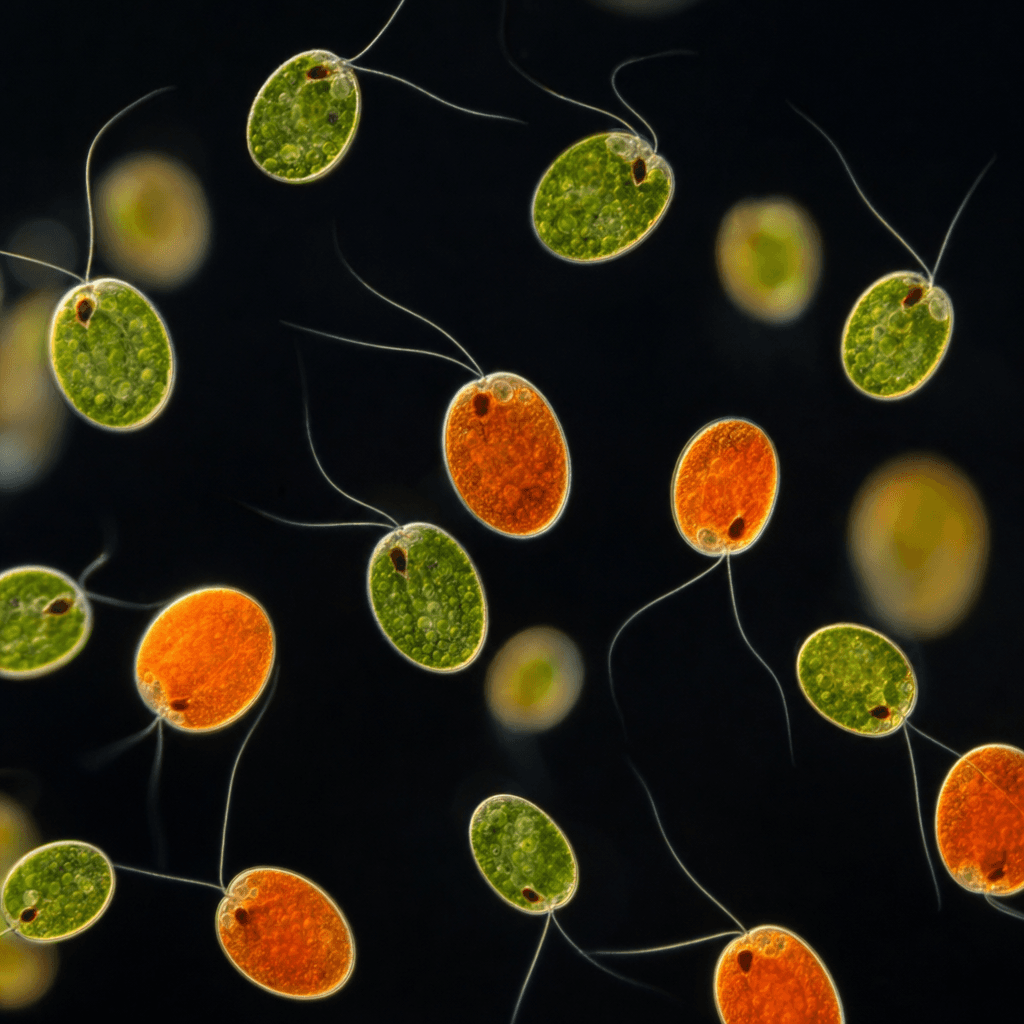
Dunaliella salina is a single-celled biflagellate green microalga that lives in hypersaline waters (salt ponds, brackish lagoons). It lacks a rigid cell wall, which gives it remarkable osmotic plasticity to tolerate very high salt concentrations. It is the leading natural source of beta-carotene: under stress (high salt and light) it accumulates this pigment and the cell shifts from green to orange-red.
Characteristics
- ▪Pear-shaped ovoid cell with two flagella and no rigid cell wall.
- ▪High osmotic tolerance: grows in hypersaline waters.
- ▪Leading natural source of beta-carotene (provitamin A).
- ▪Produces glycerol as an osmoregulator.
Cultivation
It is grown mainly in open ponds with hypersaline water, whose high salinity acts as a natural barrier against contaminants. Beta-carotene production is usually staged: a growth phase and a stress phase (high salt and light) that induces pigment accumulation.
Applications
FAQ
No: Dunaliella salina is halophilic and lives in hypersaline waters. It is one of the few microalgae that tolerates very high salt concentrations.
It accumulates beta-carotene (an orange carotenoid) as protection against the stress of high salt and light.
Sources
- Richmond, A. & Hu, Q. (eds.) (2013). Handbook of Microalgal Culture: Applied Phycology and Biotechnology. Wiley-Blackwell.
- Spolaore, P. et al. (2006). Commercial applications of microalgae. Journal of Bioscience and Bioengineering, 101(2), 87–96.
- Khan, M.I., Shin, J.H. & Kim, J.D. (2018). The promising future of microalgae: current status, challenges, and optimization of a sustainable and renewable industry for biofuels, feed, and other products. Microbial Cell Factories, 17:36.
Scientific outreach based on specialised literature. Scientific review: pending.