
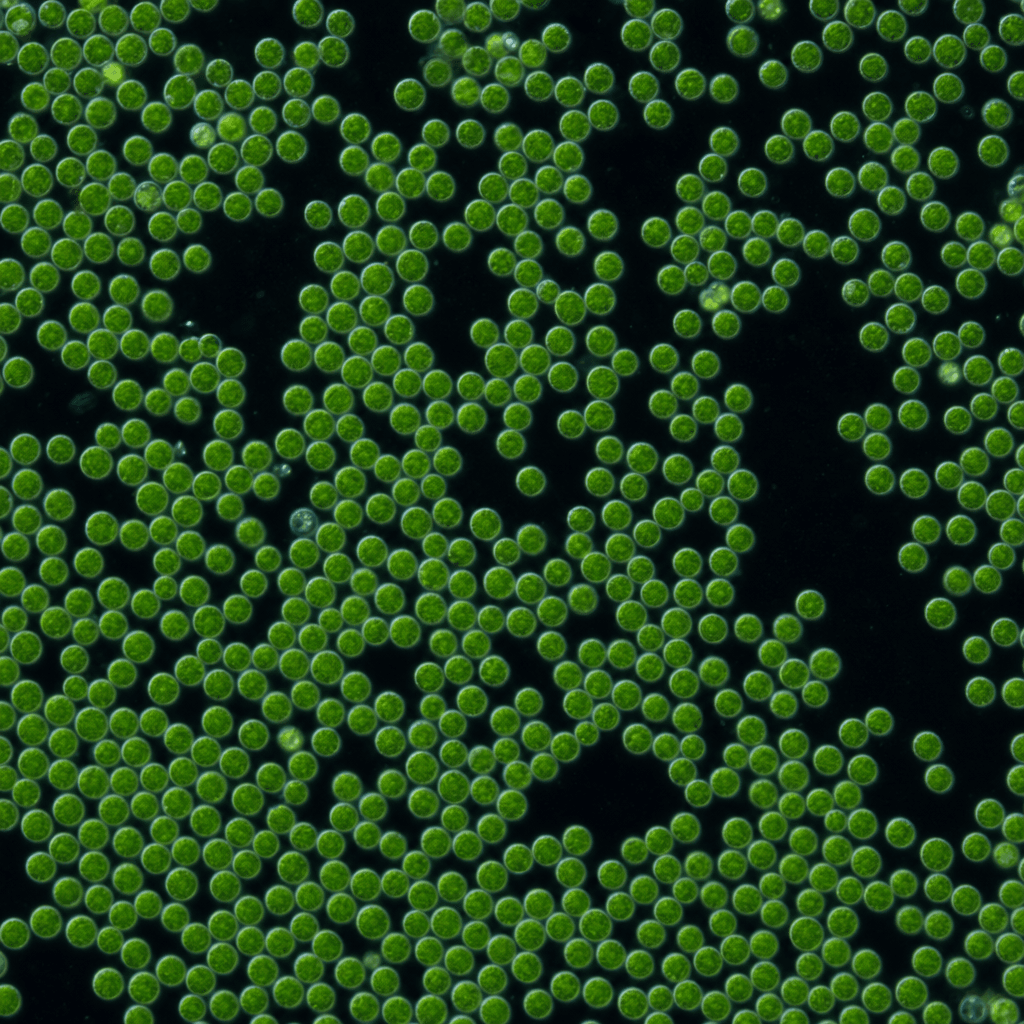
Nannochloropsis is a genus of very small microalgae (2–5 µm), mostly marine, in the eustigmatophyte group. Its cells are spherical, without flagella, and contain chlorophyll a (they lack chlorophyll b and c). It stands out for its high lipid content and, in particular, EPA (eicosapentaenoic acid, an omega-3), which makes it widely studied for aquaculture and biofuels.
Characteristics
- ▪Tiny spherical cell (2–5 µm), without flagella.
- ▪Chlorophyll a only (no chlorophyll b or c).
- ▪High lipid content and EPA (omega-3).
- ▪Robust cultivation in marine or brackish medium.
Cultivation
It is grown both in closed photobioreactors and in ponds, in marine or brackish medium. Its robustness and high lipid productivity have made it one of the reference microalgae for omega-3 production and biodiesel studies.
Applications
FAQ
As live feed and to enrich rotifers and brine shrimp thanks to its high EPA content, an omega-3 essential for fish larvae.
Not exactly: it belongs to the eustigmatophytes. It is green due to chlorophyll a, but lacks chlorophyll b and c, unlike green algae (Chlorophyta).
Sources
- Richmond, A. & Hu, Q. (eds.) (2013). Handbook of Microalgal Culture: Applied Phycology and Biotechnology. Wiley-Blackwell.
- Spolaore, P. et al. (2006). Commercial applications of microalgae. Journal of Bioscience and Bioengineering, 101(2), 87–96.
- Khan, M.I., Shin, J.H. & Kim, J.D. (2018). The promising future of microalgae: current status, challenges, and optimization of a sustainable and renewable industry for biofuels, feed, and other products. Microbial Cell Factories, 17:36.
Scientific outreach based on specialised literature. Scientific review: pending.