
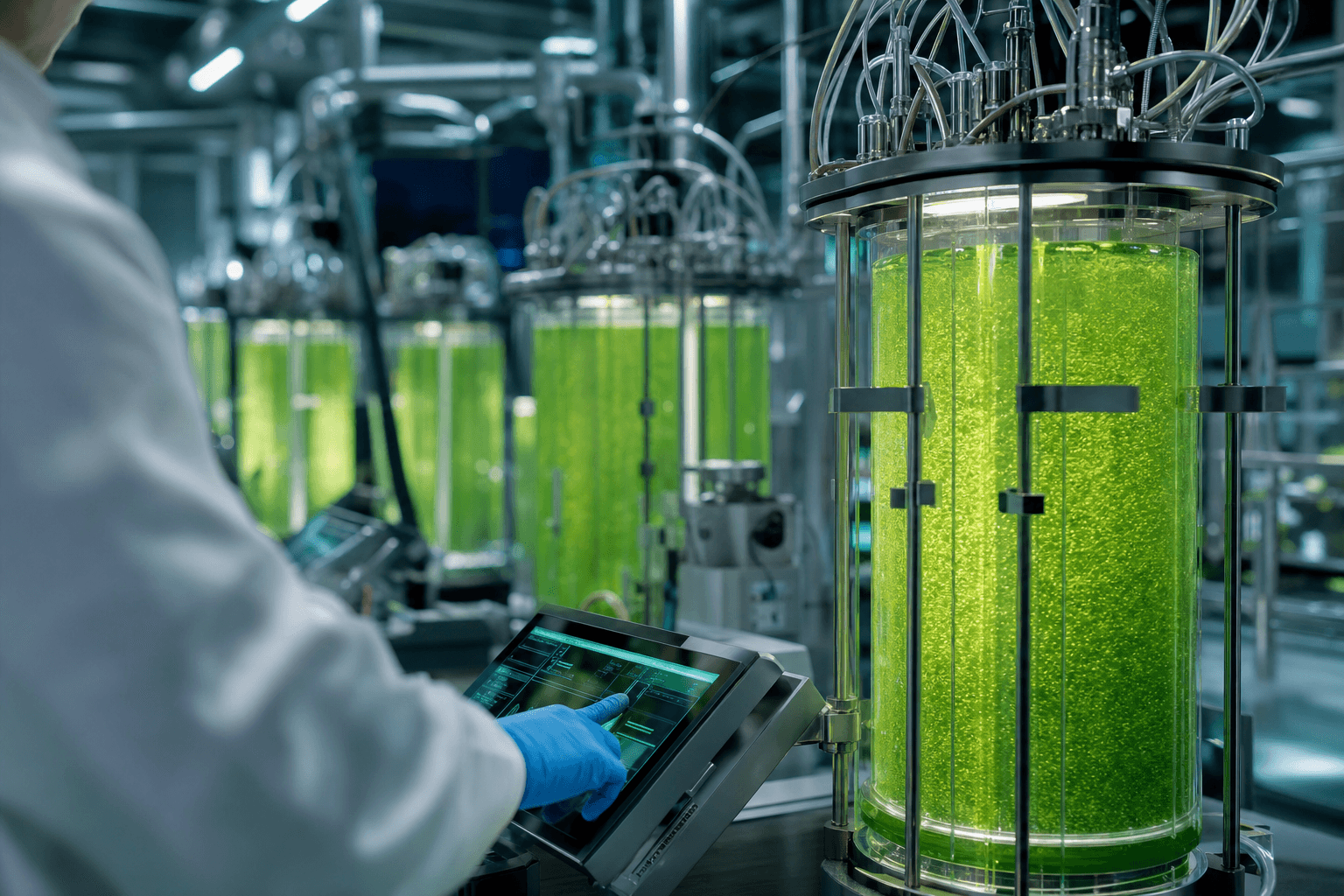
Cell engineering
Cell engineering in microalgae covers the selection, isolation and adaptation of strains aimed at favouring traits of interest: faster growth, higher content of a specific compound (pigments, lipids, proteins) or better tolerance to cultivation conditions. These processes build on the fundamental biology of the cell —its photosynthesis, cell wall and metabolism— to steer production towards the desired product.
Common approaches in the field include selecting strains from culture banks, gradually adapting them to a medium or a light intensity, and studying the metabolic pathways that regulate the accumulation of bioactive compounds. The general goal is to obtain stable, reproducible cultures that keep their properties over time.
Cultivation systems
Microalgae cultivation is carried out mainly in two types of systems: open ponds —such as raceway channels— and closed systems. Open ponds have lower costs and are simple to operate, but offer less control over temperature, light and contamination risk. The choice of system shapes productivity, culture purity and production cost.
In all cases, growth depends on four main parameters: light, temperature, carbon dioxide and nutrients (mainly nitrogen and phosphorus). Properly managing these factors is the basis of any cultivation system, whether for research or scale production. You can find more detail in the microalgae cultivation section.
See microalgae cultivation →Photobioreactors
A photobioreactor is a closed system designed to grow microalgae under controlled conditions, exposing the culture to light through transparent surfaces —tubes, flat panels or columns—. Being closed, they allow finer control of temperature, CO₂ supply, pH and nutrient concentration, and reduce the risk of contamination by other organisms.
Compared with open ponds, photobioreactors usually reach higher cell densities and purer cultures, at the cost of greater expense and operational complexity. That is why they are especially suited to producing high-value biomass or to maintaining strains that require strict, reproducible conditions.
Scalable production
Scaling up a microalgae culture means moving from small laboratory volumes to progressively larger production volumes while keeping the culture stable at each step. Work is usually staged —from flask to inoculum, and from there to production reactors or ponds— so the cell population gradually adapts to each change of scale.
The challenge of scaling is preserving biomass productivity and quality as the volume grows, since parameters such as light penetration, culture mixing and gas exchange behave differently in large systems. A well-designed scale-up is what lets a laboratory process reach reproducible industrial production.
Automation
Automation applies sensors and control systems to continuously monitor and regulate culture parameters: temperature, pH, light, dissolved oxygen, CO₂ and cell density. Keeping these variables within optimal ranges automatically improves batch-to-batch consistency and reduces the variability inherent in manual operation.
Automated systems make it possible to record the culture's evolution over time and act on it —dosing nutrients, adjusting aeration or lighting— without constant operator intervention. In biomass production, this fine control is key to sustaining productivity and detecting any deviation early.
Applied AI
Artificial intelligence and data analysis are used in microalgae biotechnology to interpret the large volume of information produced by sensors and cultivation systems. From this data it is possible to model culture behaviour, anticipate its evolution and support decisions on when and how to adjust production parameters.
As a field, AI applied to cultivation aims to optimise the use of resources —light, nutrients and energy—, predict biomass growth and improve process reproducibility. It is a tool that complements automation: where automation controls, data analytics helps to understand and optimise.
Microbiological control
Microbiological control safeguards culture purity, preventing other organisms —bacteria, fungi, protozoa or unwanted microalgae— from competing with the target strain or compromising biomass quality. It involves periodic monitoring of the culture, usually through microscope observation and sample analysis, to detect contamination early.
Good hygiene practices, properly prepared media and equipment, and systematic monitoring are the basis of a healthy, reproducible culture. In closed systems such as photobioreactors, microbiological control is more demanding but also more effective, because the culture is isolated from the environment.
Biomass optimisation
Biomass optimisation seeks to obtain the greatest amount and quality of product per unit of resource used. This includes maximising culture productivity, but also steering the cells' metabolism towards accumulating the compounds of interest —proteins, pigments, lipids or polysaccharides— by adjusting conditions such as light, nutrients or culture phase.
Once produced, biomass is harvested, concentrated and processed for its final use. Harvesting and drying stages are also part of optimisation, as they determine overall yield and the preservation of active compounds. The combination of these decisions defines the efficiency and sustainability of the production process.
Frequently asked questions
Open ponds (raceway type) are cheaper and simpler to operate, but offer less control over temperature, light and contamination. Photobioreactors are closed systems that allow finer control of conditions and purer cultures, at the cost of greater expense and complexity.
The four main parameters are light, temperature, carbon dioxide and nutrients (mainly nitrogen and phosphorus). Managing them properly is the basis of any cultivation system, whether for research or scale production.
Automation uses sensors and control systems to continuously monitor and regulate culture parameters. It improves batch-to-batch consistency, reduces the variability of manual operation and helps detect any deviation early.
AI and data analysis help interpret the information generated by sensors, model culture behaviour and predict its evolution, which supports optimising the use of light, nutrients and energy and improves process reproducibility.
Outreach content on the general technology of microalgae production. ALGACEL's specific capabilities are pending validation.