
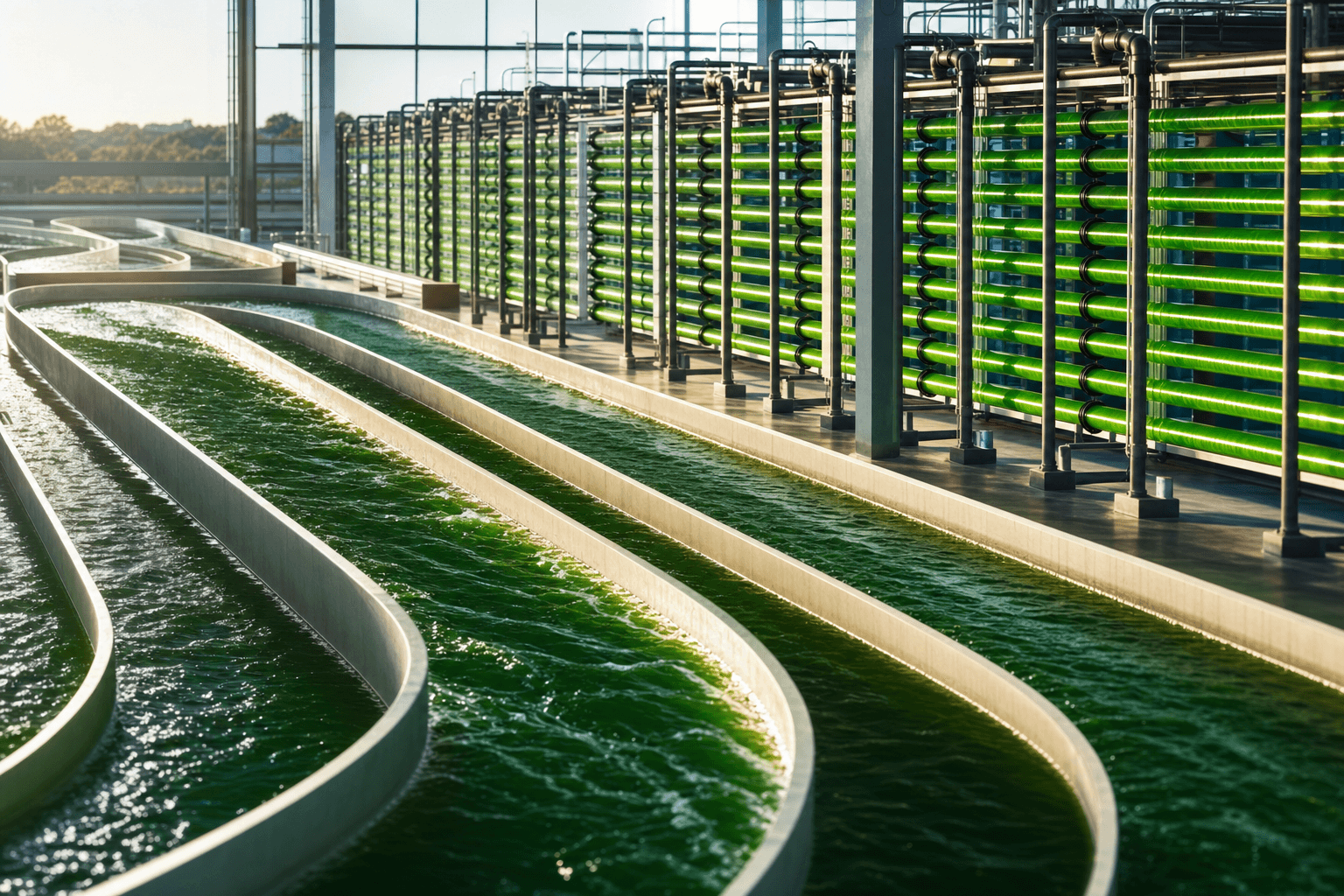
Cultivation principles
Cultivating microalgae means providing and controlling the factors they need to grow: light, carbon dioxide (CO₂), water, nutrients (especially nitrogen and phosphorus) and suitable temperature and pH conditions. The goal is to maximise biomass productivity per unit area and time.
There are two main families of cultivation systems: open systems (ponds) and closed photobioreactors. The choice depends on the species, the target product and the affordable cost.
Open systems (raceway)
Raceway open ponds are shallow loop-shaped channels stirred by a paddlewheel that keeps cells in suspension and homogenises light and nutrients. They are the cheapest and easiest to scale, so they dominate the commercial production of robust species such as Spirulina, Chlorella or Dunaliella.
Their downside is less control: they are exposed to contamination by other organisms, to evaporation and to light and temperature variability. They are therefore usually reserved for species that tolerate extreme conditions (for example, Spirulina in alkaline waters).
Closed photobioreactors
Photobioreactors (PBRs) are closed systems that isolate the culture from the outside, allowing greater control, less contamination, higher cell densities and more reproducible biomass quality. In exchange, their investment and operating cost is higher.
The main types are: tubular (transparent tubes through which the culture circulates), flat-panel (thin plates that maximise the illuminated surface), column or bubble (aerated vertical columns) and vertical (which optimise space use and light capture). Each geometry seeks a balance between illuminated surface, mixing, gas transfer and cost.
Lighting
Light is, in most cases, the limiting factor of cultivation. It can be natural (sunlight, free but variable) or artificial via LEDs, which allow control of intensity and spectrum (photosynthetically active radiation or PAR, from 400 to 700 nm).
Both too much and too little light reduce productivity: too high an intensity can cause photoinhibition, while insufficient lighting limits photosynthesis. The system design aims to distribute light homogeneously among all cells.
Nutrients and CO₂
Microalgae need a carbon source (usually CO₂, often injected to speed up growth and improve carbon capture) and macronutrients, mainly nitrogen and phosphorus. They also require micronutrients such as iron, magnesium or trace elements.
Adjusting the nutrient ratio makes it possible to steer the biomass composition: for example, nitrogen limitation favours the accumulation of lipids or certain pigments.
Water parameters
Cultivation is controlled by monitoring parameters such as pH (each species has its optimal range: Spirulina thrives in alkaline waters, while Chlorella prefers near-neutral values), temperature, conductivity and dissolved oxygen.
Excessive oxygen accumulation, a product of photosynthesis itself, can inhibit growth, so its degassing is a key design aspect, especially in closed photobioreactors.
Contamination and control
Maintaining a monoculture is one of the great challenges, especially in open systems. Cultures can be contaminated with other algae, protozoa, fungi or bacteria that compete with or prey on the species of interest.
Control strategies include the use of selective conditions (such as high pH for Spirulina), continuous microbiological monitoring, proper inoculum management and, when maximum purity is required, cultivation in closed photobioreactors.
Scale-up: from lab to industry
Production starts in the laboratory (flasks and plates), where strains are maintained and the inoculum is prepared. From there it is scaled up progressively: larger-volume cultures, a pilot plant and, finally, industrial production in large ponds or photobioreactors.
The great challenge of scale-up is preserving the productivity and purity of the culture as the volume grows, maintaining light, mixing, gas transfer and contamination control.
Cultivation systems in detail
Frequently asked questions
The open pond (raceway) is cheap and easy to scale, but offers less control and more contamination risk. The photobioreactor is closed: more control, higher density and purity, but more expensive.
Light, CO₂, water, nutrients (especially nitrogen and phosphorus) and suitable temperature and pH conditions.
Mainly tubular, flat-panel, column or bubble and vertical, each with a different balance between illuminated surface, mixing and cost.
Because it can be contaminated with other algae, protozoa, fungi or bacteria; it is controlled with selective conditions, monitoring and, if needed, closed systems.
Sources
- Richmond, A. & Hu, Q. (eds.) (2013). Handbook of Microalgal Culture: Applied Phycology and Biotechnology. Wiley-Blackwell.
- Chisti, Y. (2007). Biodiesel from microalgae. Biotechnology Advances, 25(3), 294–306.
- Spolaore, P. et al. (2006). Commercial applications of microalgae. Journal of Bioscience and Bioengineering, 101(2), 87–96.
- Mata, T.M. et al. (2010). Microalgae for biodiesel production and other applications: A review. Renewable and Sustainable Energy Reviews, 14(1), 217–232.
- FAO (2008). A review on culture, production and use of Spirulina as food for humans. FAO Fisheries and Aquaculture Circular.
- Borowitzka, M.A. (2013). High-value products from microalgae—their development and commercialisation. Journal of Applied Phycology, 25, 743–756.
- Khan, M.I., Shin, J.H. & Kim, J.D. (2018). The promising future of microalgae: current status, challenges, and optimization of a sustainable and renewable industry for biofuels, feed, and other products. Microbial Cell Factories, 17:36.
- Kumar, G. et al. (2020). Bioengineering of Microalgae: Recent Advances, Perspectives, and Regulatory Challenges for Industrial Application. Frontiers in Bioengineering and Biotechnology, 8:914.
- Barkia, I., Saari, N. & Manning, S.R. (2019). Microalgae for High-Value Products Towards Human Health and Nutrition. Marine Drugs, 17(5):304.
- Acién, F.G., Fernández, J.M., Magán, J.J. & Molina, E. (2012). Production cost of a real microalgae production plant and strategies to reduce it. Biotechnology Advances, 30(6), 1344–1353.
- Metzger, P. & Largeau, C. (2005). Botryococcus braunii: a rich source for hydrocarbons and related ether lipids. Applied Microbiology and Biotechnology, 66(5), 486–496.
- Malcangi, G. et al. (2026). The Role of Astaxanthin as an Antioxidant and Anti-Inflammatory Agent in Human Health: A Systematic Review. International Journal of Molecular Sciences, 27(2):700.
Scientific outreach based on specialised literature. Scientific review: pending.