
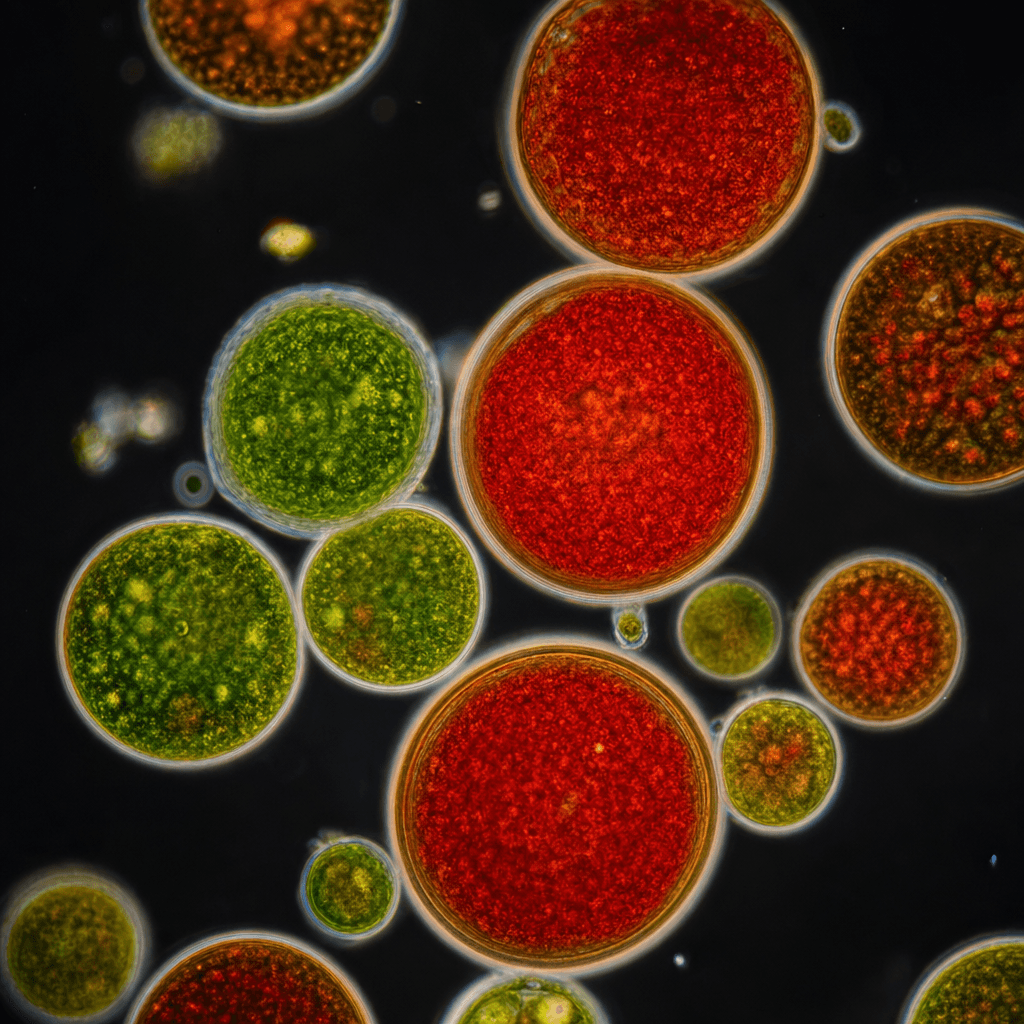
Haematococcus pluvialis is a freshwater green microalga famous for accumulating astaxanthin, a red carotenoid with high antioxidant capacity. It is the richest known natural source of astaxanthin: it can store it at up to around 5 % of its dry weight, and that pigment makes up between 80 % and 99 % of its carotenoids. Under stress (high light or nutrient depletion), it shifts from green flagellated cells to red cysts loaded with astaxanthin.
Characteristics
- ▪Two phases: green motile cell and red cyst (aplanospore).
- ▪Richest natural source of astaxanthin: up to ≈ 5 % of dry weight.
- ▪Astaxanthin makes up 80–99 % of its carotenoids.
- ▪Usually cultivated in two stages (green → red).
Cultivation
It is grown in two stages: first a green growth phase in closed photobioreactors, then a stress phase (high light, nutrient limitation) to induce astaxanthin accumulation. It requires control to avoid contamination.
Applications
FAQ
It accumulates astaxanthin (a red carotenoid) as a protective mechanism against stress, especially high light and nutrient scarcity.
It is the richest known natural source: it can reach around 5 % of its dry weight in astaxanthin, which represents between 80 % and 99 % of its carotenoids.
Sources
- Malcangi, G. et al. (2026). The Role of Astaxanthin as an Antioxidant and Anti-Inflammatory Agent in Human Health: A Systematic Review. International Journal of Molecular Sciences, 27(2):700.
- Richmond, A. & Hu, Q. (eds.) (2013). Handbook of Microalgal Culture: Applied Phycology and Biotechnology. Wiley-Blackwell.
- Spolaore, P. et al. (2006). Commercial applications of microalgae. Journal of Bioscience and Bioengineering, 101(2), 87–96.
- Khan, M.I., Shin, J.H. & Kim, J.D. (2018). The promising future of microalgae: current status, challenges, and optimization of a sustainable and renewable industry for biofuels, feed, and other products. Microbial Cell Factories, 17:36.
Scientific outreach based on specialised literature. Scientific review: pending.