
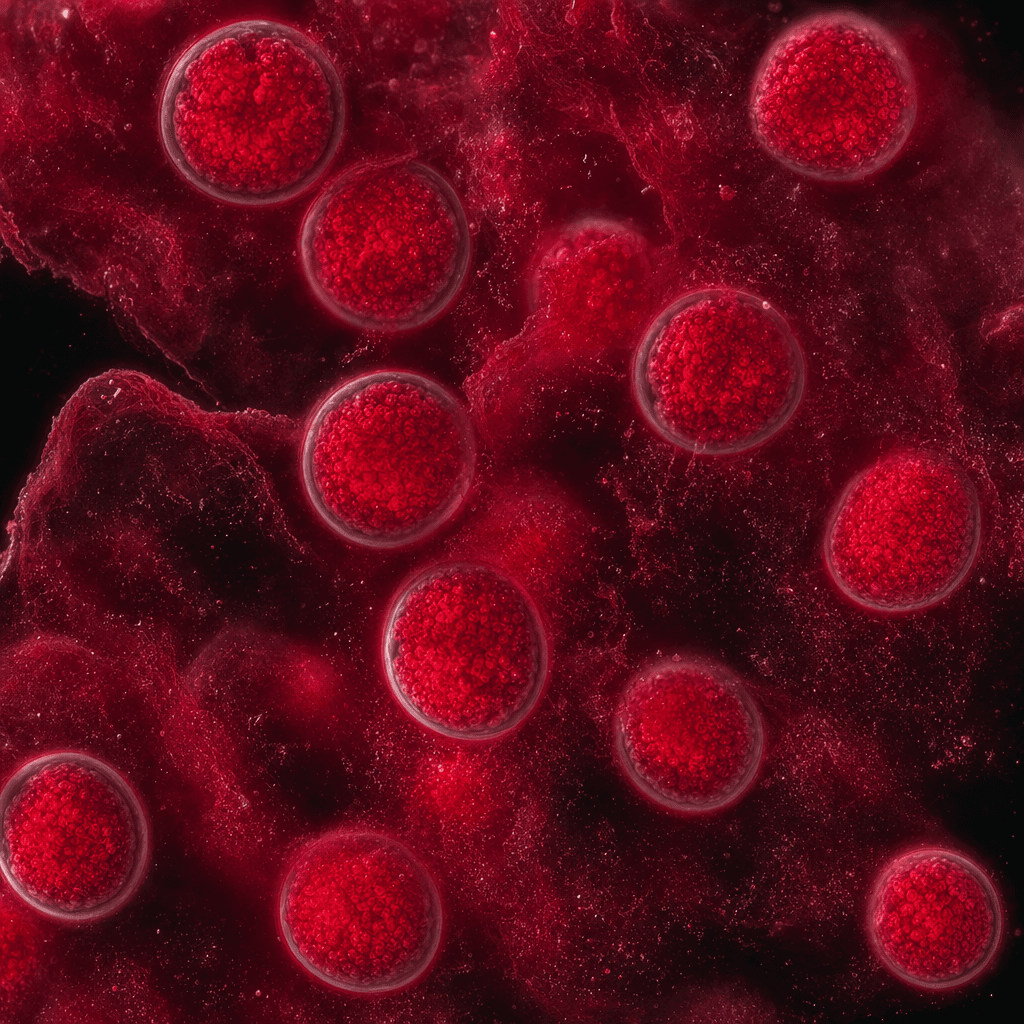
Porphyridium cruentum is a unicellular red microalga, without a rigid cell wall, surrounded by a matrix of sulfated polysaccharides that gives it a mucilaginous appearance. Its red colour comes from phycoerythrin, a high-value phycobiliprotein. It stands out for those sulfated exopolysaccharides and for its pigment, both of interest in cosmetics, health and diagnostics.
Characteristics
- ▪Red colour from phycoerythrin (a phycobiliprotein).
- ▪Surrounded by a sulfated-polysaccharide matrix.
- ▪No rigid cell wall.
- ▪Source of polyunsaturated fatty acids (strain-dependent).
Cultivation
It is grown in marine or saline medium in photobioreactors, where it produces abundant polysaccharide mucilage that can be recovered together with the biomass. Light control is needed to favour phycoerythrin synthesis.
Applications
FAQ
It is a red fluorescent pigment (a phycobiliprotein) characteristic of red algae; it is used as a natural colorant and as a fluorescent marker in diagnostics and research.
Sources
- Richmond, A. & Hu, Q. (eds.) (2013). Handbook of Microalgal Culture: Applied Phycology and Biotechnology. Wiley-Blackwell.
- Spolaore, P. et al. (2006). Commercial applications of microalgae. Journal of Bioscience and Bioengineering, 101(2), 87–96.
- Khan, M.I., Shin, J.H. & Kim, J.D. (2018). The promising future of microalgae: current status, challenges, and optimization of a sustainable and renewable industry for biofuels, feed, and other products. Microbial Cell Factories, 17:36.
Scientific outreach based on specialised literature. Scientific review: pending.