
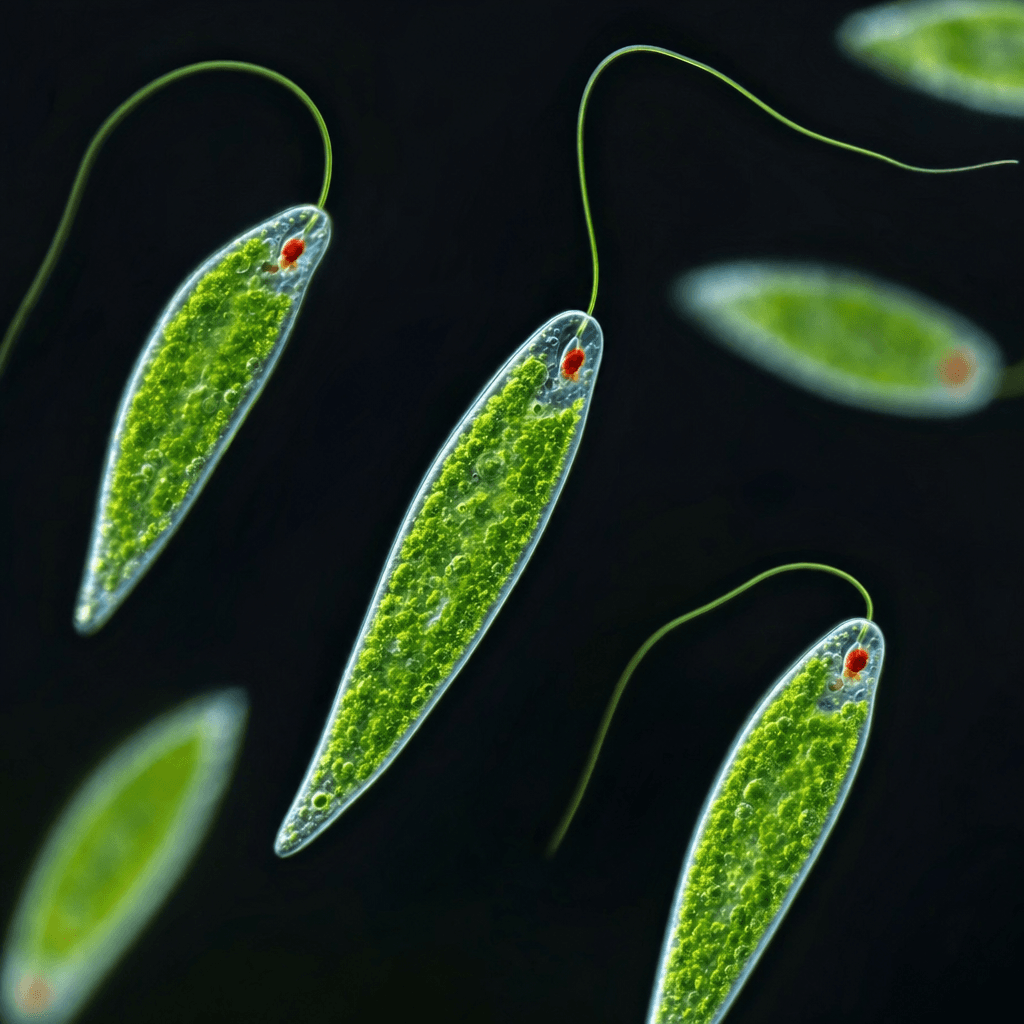
Euglena gracilis is a freshwater flagellate microorganism, mixotrophic: it can photosynthesise and, at the same time, feed on organic matter. It has a light-sensitive eyespot (stigma) and a flagellum for movement, and lacks a rigid cell wall (it has a flexible pellicle). It stores energy as paramylon, a β-1,3-glucan unique to this group. It is a model organism and a source of protein, vitamins and paramylon.
Characteristics
- ▪Mixotrophic: photosynthesis + heterotrophic nutrition.
- ▪Eyespot (stigma) and flagellum to swim toward light.
- ▪Stores paramylon (β-1,3-glucan).
- ▪No rigid wall: a flexible pellicle that lets it change shape.
Cultivation
It is grown in fresh water in autotrophic, heterotrophic or mixotrophic mode, which gives process flexibility. It tolerates acidic pH, which helps reduce contamination, and reaches high densities in photobioreactors.
Applications
FAQ
It is a euglenoid, a mixotrophic flagellate protist; it is grouped with microalgae for its photosynthesis and cultivation, although it shares traits with protozoa.
Sources
- Richmond, A. & Hu, Q. (eds.) (2013). Handbook of Microalgal Culture: Applied Phycology and Biotechnology. Wiley-Blackwell.
- Spolaore, P. et al. (2006). Commercial applications of microalgae. Journal of Bioscience and Bioengineering, 101(2), 87–96.
- Khan, M.I., Shin, J.H. & Kim, J.D. (2018). The promising future of microalgae: current status, challenges, and optimization of a sustainable and renewable industry for biofuels, feed, and other products. Microbial Cell Factories, 17:36.
Scientific outreach based on specialised literature. Scientific review: pending.