
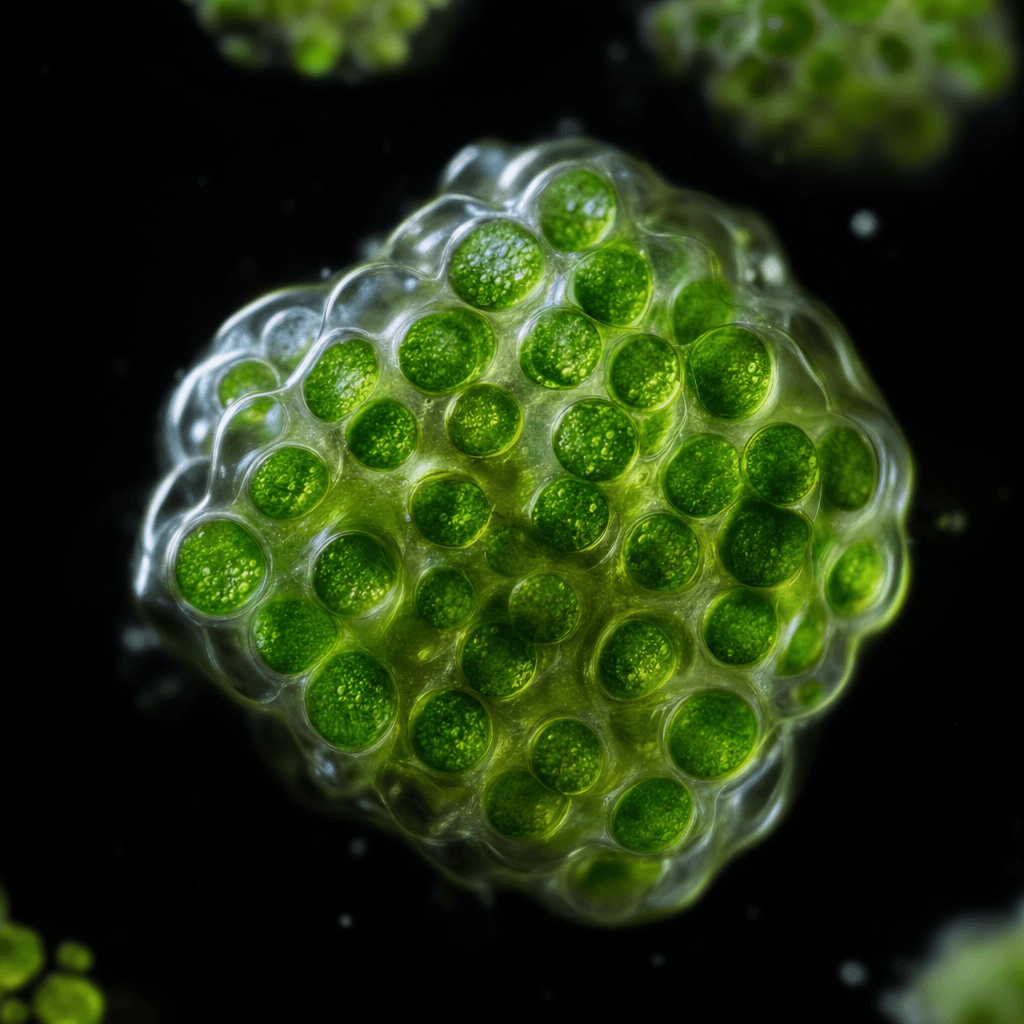
Botryococcus braunii is a colonial freshwater green microalga, famous for producing and accumulating long-chain hydrocarbons in an extracellular matrix that holds the cells together in grape-like clusters. Those hydrocarbons make it one of the most studied microalgae as a potential source of liquid biofuels, although its growth is slow.
Characteristics
- ▪Colonies of cells embedded in an extracellular matrix.
- ▪Accumulates long-chain hydrocarbons (botryococcenes).
- ▪One of the highest hydrocarbon producers among microalgae.
- ▪Slow growth compared with other species.
Cultivation
It is grown in freshwater media, in both open and closed systems. Its main challenge is slow growth, which limits productivity at scale; research therefore focuses on optimising cultivation and the extraction of the hydrocarbons it produces.
Applications
FAQ
Because it produces and accumulates long-chain hydrocarbons, similar to those in petroleum, which can be converted into liquid fuels.
Its growth is slow compared with other microalgae, which makes it hard to reach profitable large-scale production.
Sources
- Metzger, P. & Largeau, C. (2005). Botryococcus braunii: a rich source for hydrocarbons and related ether lipids. Applied Microbiology and Biotechnology, 66(5), 486–496.
- Richmond, A. & Hu, Q. (eds.) (2013). Handbook of Microalgal Culture: Applied Phycology and Biotechnology. Wiley-Blackwell.
- Spolaore, P. et al. (2006). Commercial applications of microalgae. Journal of Bioscience and Bioengineering, 101(2), 87–96.
- Khan, M.I., Shin, J.H. & Kim, J.D. (2018). The promising future of microalgae: current status, challenges, and optimization of a sustainable and renewable industry for biofuels, feed, and other products. Microbial Cell Factories, 17:36.
Scientific outreach based on specialised literature. Scientific review: pending.