
What it is
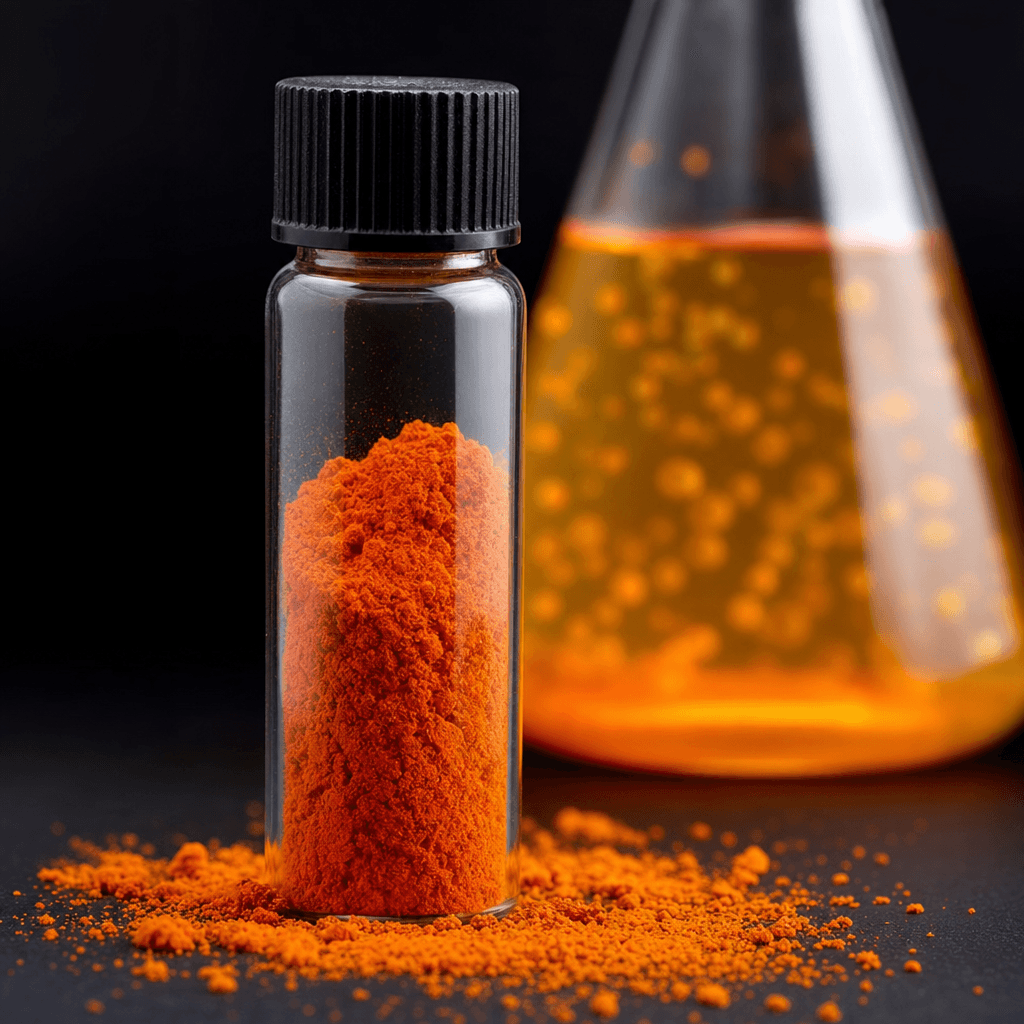
Beta-carotene is a carotenoid (a 40-carbon tetraterpenoid pigment) with an intense orange color and the best known of the vitamin A precursors, which is why it is called provitamin A: the body converts it into vitamin A (retinol) in a regulated way, according to its needs. In nature it is abundant in carrots and orange vegetables, but its richest microalgal source is Dunaliella salina, a green microalga that, under salt and high-light stress, accumulates large amounts of beta-carotene as a photoprotective mechanism, reaching a very high fraction of its dry weight and turning cultures a characteristic orange-red. Beyond acting as provitamin A, it is a lipophilic antioxidant able to quench singlet oxygen and free radicals. It is used as a natural colorant (E160a) in food and as an ingredient in nutraceuticals and cosmetics.
Uses and properties
- ▪Natural yellow-orange colorant (E160a), used as an alternative to synthetic dyes in food, beverages and cosmetics.
- ▪Provitamin A: the body converts it into vitamin A (retinol) in a regulated way, according to its needs.
- ▪Lipophilic antioxidant, studied for its ability to neutralize free radicals and singlet oxygen.
- ▪Beta-carotene from Dunaliella salina is particularly rich in the 9-cis isomer, of interest in supplements and nutraceuticals.
FAQ
It is an orange carotenoid and the best known precursor of vitamin A (provitamin A). The body converts it into vitamin A as needed, and it also acts as a lipophilic antioxidant.
Its richest natural source is the microalga Dunaliella salina, which accumulates large amounts under salt and high-light stress. It is also present in microalgae such as Chlorella and Spirulina.
No. Beta-carotene is a provitamin A: a molecule the body converts into vitamin A (retinol) when needed, unlike the preformed vitamin A of animal origin.
It is used as a natural colorant (E160a) in food and beverages, as an antioxidant ingredient in cosmetics and nutraceuticals, and to add color in animal feed and aquaculture.
Its long chain of conjugated double bonds absorbs blue and green light and reflects orange-red tones, which also explains the color of Dunaliella salina cultures.
Sources
- Richmond, A. & Hu, Q. (eds.) (2013). Handbook of Microalgal Culture: Applied Phycology and Biotechnology. Wiley-Blackwell.
- Spolaore, P. et al. (2006). Commercial applications of microalgae. Journal of Bioscience and Bioengineering, 101(2), 87–96.
- Khan, M.I., Shin, J.H. & Kim, J.D. (2018). The promising future of microalgae: current status, challenges, and optimization of a sustainable and renewable industry for biofuels, feed, and other products. Microbial Cell Factories, 17:36.