
What it is
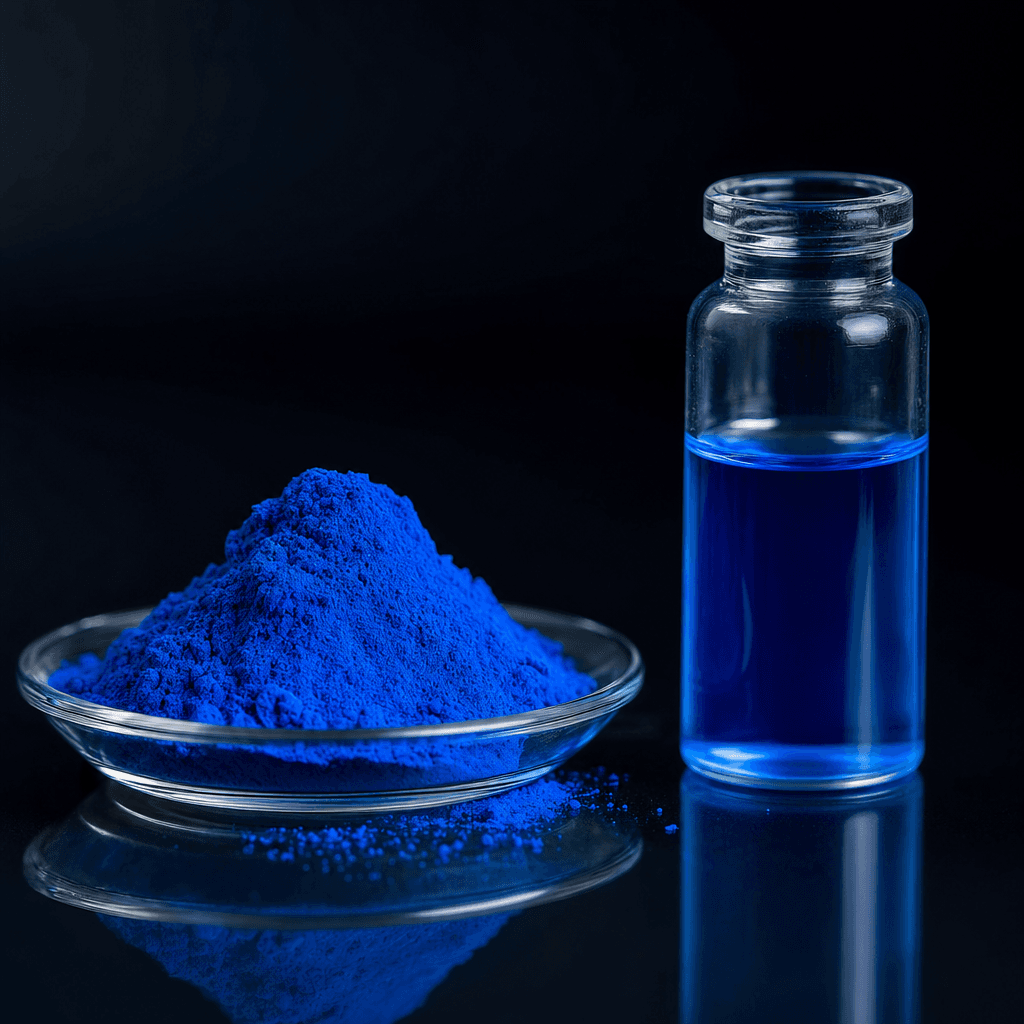
Phycocyanin is a phycobiliprotein: a water-soluble protein bound to a chromophore, phycocyanobilin, which gives it its characteristic blue color. It is part of the phycobilisomes, the light-harvesting antennae that cyanobacteria such as Spirulina (Arthrospira) use to carry out photosynthesis, absorbing the orange-red light (around 620 nm) that chlorophyll captures less efficiently. It is obtained mainly from cultivated Spirulina biomass, from which C-phycocyanin, its most abundant variant, is extracted. It matters because it is one of the few natural-origin blue colorants suitable for food, and because its protein structure is studied for its antioxidant properties and its fluorescence, useful as a marker in laboratory techniques.
Uses and properties
- ▪Natural blue food colorant, one of the few blues of non-synthetic origin.
- ▪Antioxidant capacity studied, associated with free-radical scavenging.
- ▪Fluorescent pigment used as a marker in immunoassays and cytometry.
- ▪Water-soluble, suitable for beverages, ice cream, confectionery and cosmetic formulations.
FAQ
It is a blue protein pigment (a phycobiliprotein) found in Spirulina and other cyanobacteria, where it takes part in light harvesting for photosynthesis.
It is extracted mainly from cultivated Spirulina (Arthrospira) biomass, yielding C-phycocyanin, its most abundant form.
Its color comes from phycocyanobilin, a chromophore bound to the protein that absorbs orange-red light (around 620 nm) and reflects blue.
It is used as a natural blue food colorant in beverages, confectionery and dairy, and as a fluorescent marker in research; it is also studied for its antioxidant capacity.
Yes, phycocyanin is water-soluble, which makes it easy to use in aqueous formulations such as beverages and ice cream.
Sources
- Richmond, A. & Hu, Q. (eds.) (2013). Handbook of Microalgal Culture: Applied Phycology and Biotechnology. Wiley-Blackwell.
- Spolaore, P. et al. (2006). Commercial applications of microalgae. Journal of Bioscience and Bioengineering, 101(2), 87–96.
- Khan, M.I., Shin, J.H. & Kim, J.D. (2018). The promising future of microalgae: current status, challenges, and optimization of a sustainable and renewable industry for biofuels, feed, and other products. Microbial Cell Factories, 17:36.