
What it is
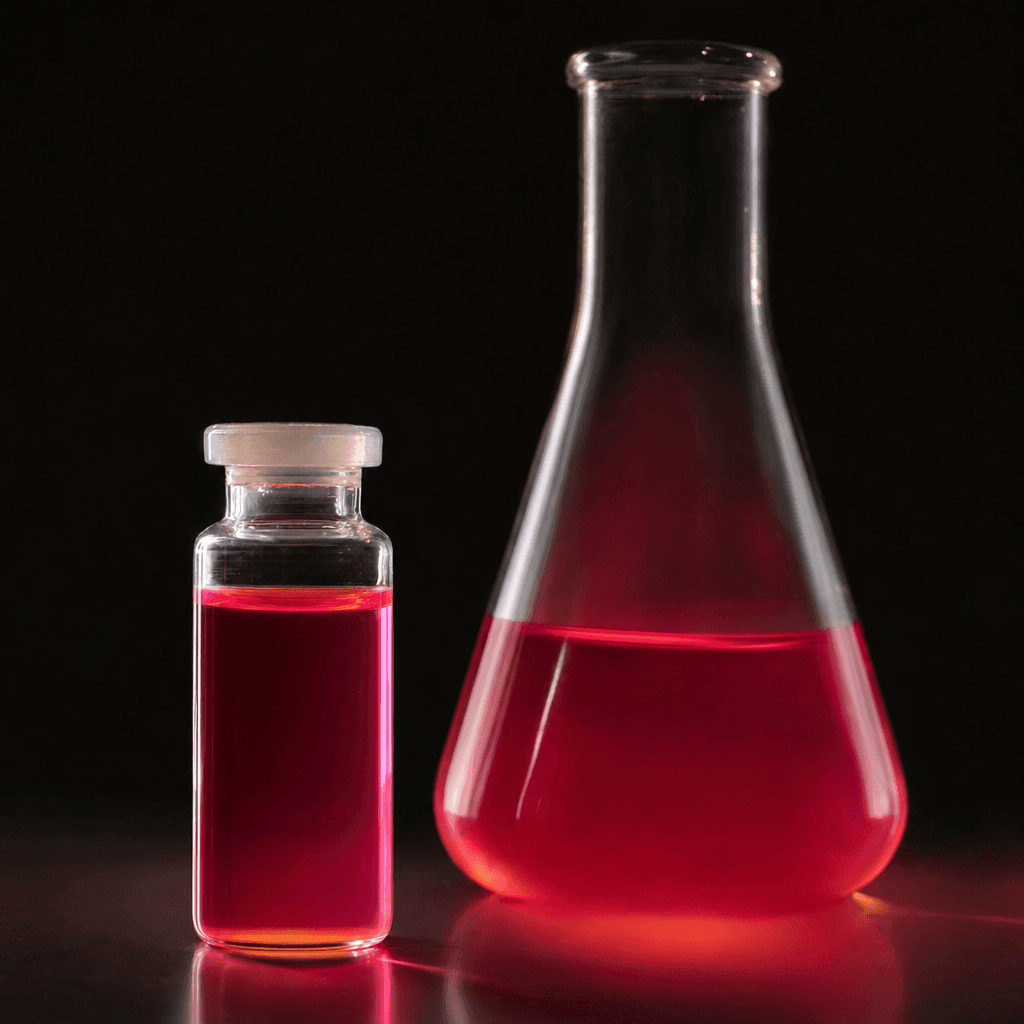
Phycoerythrin is a phycobiliprotein: a water-soluble protein bound to pigments (bilins) that give it an intense red color. It is part of the phycobilisomes, the light-harvesting antennae attached to the photosynthetic membranes of red algae (Rhodophyta) and some cyanobacteria. Its biological role is to absorb green-yellow light, which chlorophyll uses poorly, and pass that energy on to photosynthesis; this is why many of these algae display reddish tones. Among microalgae, the genus Porphyridium is one of the best-known sources of phycoerythrin. Beyond its natural role, it is prized in industry for its pink-red color as a colorant and, above all, for its bright fluorescence, which makes it a widely used marker in laboratory techniques.
Uses and properties
- ▪Natural pink-red colorant for foods, beverages and cosmetics, as an alternative to synthetic dyes.
- ▪Bright fluorescent marker widely used in flow cytometry, immunofluorescence and diagnostics (forms such as R-phycoerythrin and B-phycoerythrin are conjugated to antibodies).
- ▪Water-soluble phycobiliprotein studied for its antioxidant capacity, with interest in nutraceuticals and cosmetics.
- ▪High efficiency at capturing green light, a trait leveraged in biotechnology and as a high-intensity fluorescent probe.
FAQ
It is a phycobiliprotein, a water-soluble pink-red pigment-protein found in red algae and some cyanobacteria. It works as a light-harvesting antenna in photosynthesis.
Its best-known microalgal source is the red alga of the genus Porphyridium; it also occurs in certain cyanobacteria, such as some strains of the genus Anabaena.
It has an intense pink-red color. It absorbs green-yellow light and re-emits part of that energy as orange-red fluorescence, a property used as a marker in the laboratory.
It is used as a natural pink-red colorant in foods and cosmetics, and as a fluorescent marker in diagnostic and research techniques such as flow cytometry and immunofluorescence.
No. Both are phycobiliproteins, but phycocyanin is blue (typical of Spirulina) and phycoerythrin is red. They differ in the bilins they carry and the light they absorb.
Sources
- Richmond, A. & Hu, Q. (eds.) (2013). Handbook of Microalgal Culture: Applied Phycology and Biotechnology. Wiley-Blackwell.
- Spolaore, P. et al. (2006). Commercial applications of microalgae. Journal of Bioscience and Bioengineering, 101(2), 87–96.
- Khan, M.I., Shin, J.H. & Kim, J.D. (2018). The promising future of microalgae: current status, challenges, and optimization of a sustainable and renewable industry for biofuels, feed, and other products. Microbial Cell Factories, 17:36.