
What it is
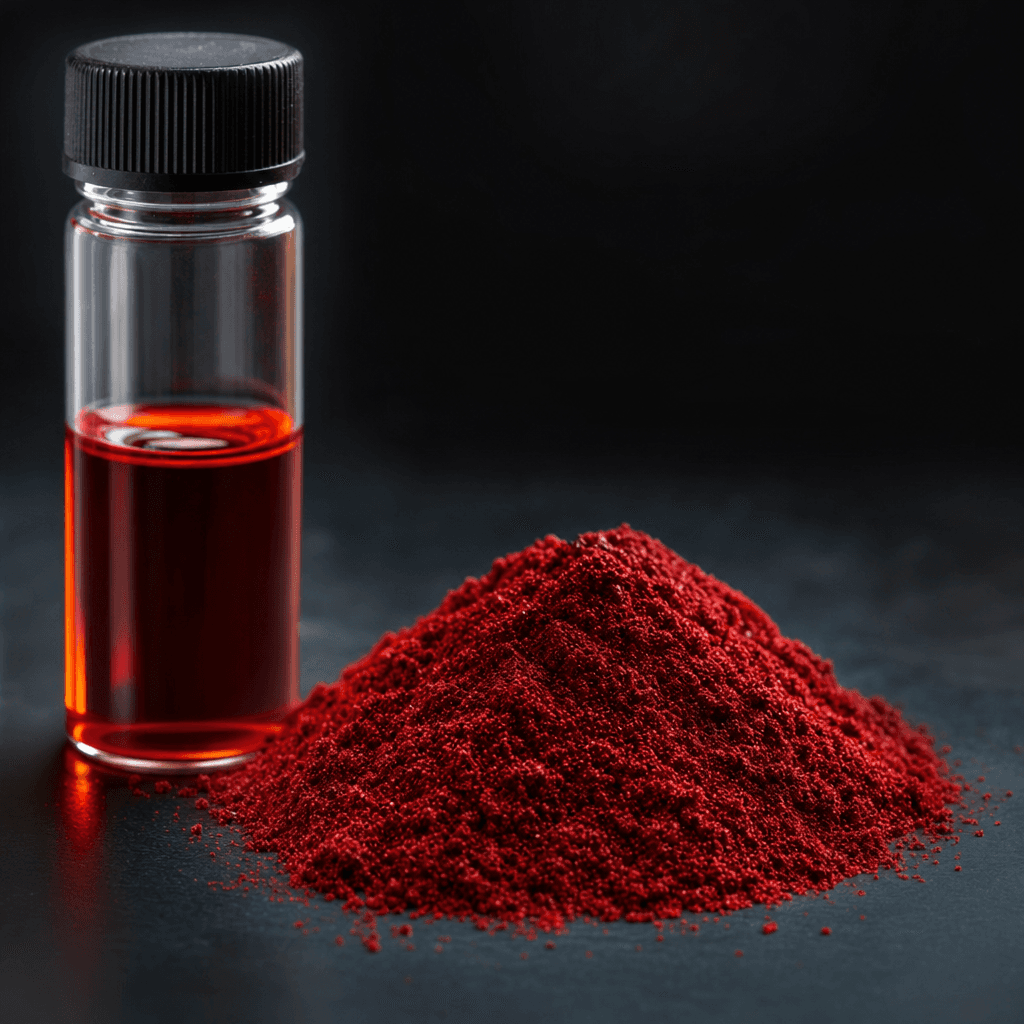
Astaxanthin is an oxygenated carotenoid belonging to the xanthophyll group, responsible for the deep red colour of many aquatic organisms. It accumulates naturally in the freshwater microalga Haematococcus pluvialis, which under stress conditions —high light intensity, nutrient scarcity— turns its green cells into red cysts where astaxanthin can reach around 5% of dry weight, the highest known natural concentration. It is one of the most effective molecules at quenching singlet oxygen and free radicals, which explains its interest in nutraceuticals and cosmetics, alongside its use as the pigment that gives colour to salmon, trout and crustaceans in aquaculture.
Uses and properties
- ▪Powerful antioxidant: it stands out among carotenoids for its ability to quench singlet oxygen and free radicals, studied for its activity against oxidative stress.
- ▪Aquaculture pigment: it provides the natural pink-orange colour of salmon, trout and crustaceans through their feed.
- ▪Cosmetic ingredient: it is used in skincare formulations for its antioxidant activity, with interest in protection against photo-ageing.
- ▪Nutraceutical supplement: it is marketed as a dietary supplement, usually as an oleoresin extracted from Haematococcus pluvialis.
FAQ
It is a red carotenoid from the xanthophyll group, known for its high antioxidant capacity. It gives colour to organisms such as salmon, flamingos and crustaceans, which obtain it through the food chain.
The richest natural source is the freshwater microalga Haematococcus pluvialis, able to accumulate astaxanthin up to around 5% of its dry weight. Other microalgae, such as Chromochloris (Chlorella) zofingiensis, also produce it in smaller amounts.
Its carotenoid structure, with a long chain of conjugated double bonds and oxygenated groups at each end, absorbs blue-green light and reflects red. That is why Haematococcus turns from green to deep red as it accumulates it.
It is used as a pigment in the feed of fish and crustaceans in aquaculture, as a nutraceutical supplement for its antioxidant activity, and as a cosmetic ingredient. It is also studied with interest in the field of health.
Yes. Synthetic astaxanthin is manufactured from petrochemical derivatives and is used mainly in aquaculture, whereas the natural form from Haematococcus pluvialis has a different isomeric configuration and is usually preferred for nutraceuticals and cosmetics.
Sources
- Malcangi, G. et al. (2026). The Role of Astaxanthin as an Antioxidant and Anti-Inflammatory Agent in Human Health: A Systematic Review. International Journal of Molecular Sciences, 27(2):700.
- Richmond, A. & Hu, Q. (eds.) (2013). Handbook of Microalgal Culture: Applied Phycology and Biotechnology. Wiley-Blackwell.
- Spolaore, P. et al. (2006). Commercial applications of microalgae. Journal of Bioscience and Bioengineering, 101(2), 87–96.
- Khan, M.I., Shin, J.H. & Kim, J.D. (2018). The promising future of microalgae: current status, challenges, and optimization of a sustainable and renewable industry for biofuels, feed, and other products. Microbial Cell Factories, 17:36.